3.2.25
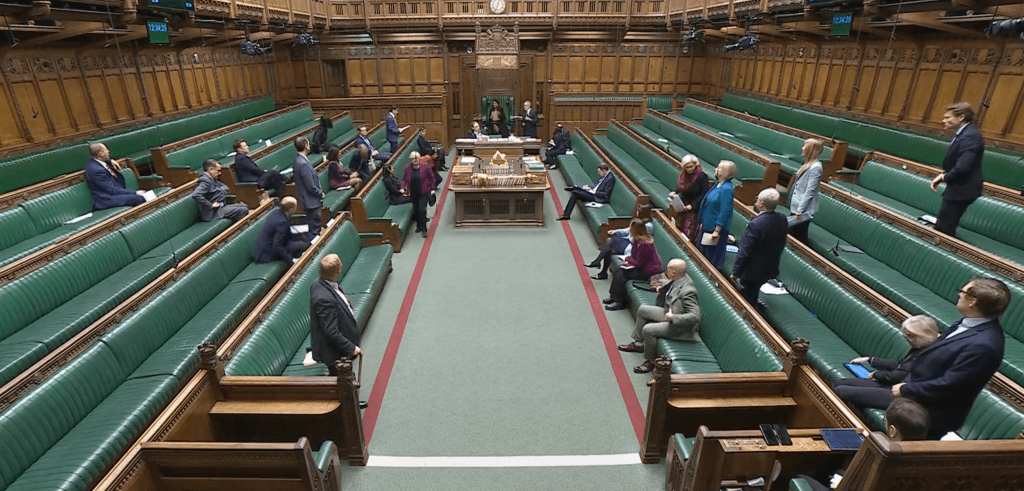
LONDON: Green seats were plentiful on thursday in the house of commons for a debate on proportional representation.
In December mps voted in favour of proportional representation for the first time in history. However, the government have prevented the bill from progressing by not allowing time for its second reading.
On thursday the notion of proportional representation for general elections was debated, rather than the bill brought in December.
Among the few mps who attended a debate on how the political system might be improved there was widespread agreement, in favour of proportional representation.
The voting system for westminster elections is so called first past the post: the candidate with the most votes in any constituency wins and is the sole mp for that area. In proportional representation, all votes would be represented in the house of commons, so if twenty percent vote for the green party, twenty percent of the seats will belong the green mps, if labour gains forty percent of the vote, forty percent of the seats will be for labour mps.
First past the post is a system rarely found outside england, away from the supposedly sacrosanct traditions of westminster.
“Our first past the post electoral system is not working. It is desperately in need of an upgrade, and we need seriously to consider the alternatives … I want to encourage the Government to be bold and to be honest about how unrepresentative British general elections have become,” labour mp Alex Sobel said.
“These growing failures of representative democracy, the widespread feeling that ordinary people do not have a fair say over who speaks for them or how they are governed, are feeding the record low levels of trust in politics and faith in democracy, and that should worry all of us,” Sobel added.
Eight five percent of mps were elected without a majority in their constituencies, Sobel said.
“This is the most disproportionate house of commons in british history, with labour mps in sixty six percent of seats but with the lowest vote share, some thirty four percent, of any winning party since nineteen forty five, and fifty eight percent of uk voters did not get the mp they voted for. I have previously described first past the post as ‘barely democratic’ and these figures vindicate me.,” said liberal democrat mp Cameron Thomas.
Forty of forty three countries in Europe have proportional representation of some kind, labour mp Andrew Ranger said. Three of those are northern ireland, scotland and wales.
Reform uk mp Richard Tice had reason to be angry about the first past the post system. “The governing party has about 34% of the votes cast, but 63% of the seats in this great house. What sort of system is that? It is completely unrepresentative. My good party had 14% of votes cast, yet we do not have even a mere 1% of seats in the Chamber. As for the other smaller parties, the Green party had just under 7% of votes cast, but has about 0.5% of the seats in the Chamber. That is so damaging to trust in democracy,” he said.
Labour mp Jas Athwal spoke against proportional representation. It “is not the panacea that everybody is talking about today.
In 2011, we put the question to the British people. They overwhelmingly rejected the alternative vote system, choosing to stick with first past the post … I am accountable to the people of ilford south, and I take my role and my relationship with my constituents seriously. Under a pr voting system, the personal and local links that I so value with my constituents would be lost,” he said.
“No one votes for coalition governments. Instead, they are created by agreements hammered out in dark rooms, behind closed doors, they are frankenstein governments, which undermine the popular vote,” Athwal added.
Liberal democrat mp Sarah Olney introduced the bill for proportional representation in december which won at its first reading. “It has not been given parliamentary time to allow it to progress through the legislative process. If we want to continue to be a beacon of democracy across the world, we must ensure that it serves its purpose both in giving a voice to the people and in delivering prosperity and stability. We cannot do the latter if we fail at the former,” she said.
“It would be an outrage were this bill not given the opportunity to progress further through the house and to become law, so I urge the minister to schedule an opportunity for the bill to be read a second time, in government time, and to offer labour mps a free vote on the bill,” she added.
Conservative mp Paul Holmes spoke about the virtues of first past the post and rejected proportional representation. “We should not trade a proven system for one that prioritises theoretical fairness over practical effectiveness,” he said.
Labour mp and parliamentary under-secretary of state for homelessness and democracy Rushanara Ali spoke about how wonderful uk democracy is. “The uk’s democratic system and institutions are strong and are rightly held the world over as a strong example of democracy. I know as someone who was born in another country that the UK’s democratic system has provided inspiration,” she said.
Ali added that the government does not plan to change the voting system to the house of commons or to create a national commission on electoral reform, as many mps in the debate demanded.
Most of the mps who spoke in opposition of proportional representation cited a referendum from 2011, the same vote Athwal referred to, where alternative voting was proposed and defeated, thereby maintaining first past the post. Those mps confused alternative voting with proportional representation.
Sobel provided the correction. “We had a referendum on the alternative vote system in 2011. The alternative vote system … is a preferential system, not a proportional system, so we have had a referendum on preferential representation but we have never had a referendum on proportional representation. I do not see why we need to wait a generation, as has been suggested. I certainly do not think that we need to have another referendum on a preferential system, but we need to consider, as I laid out in the debate, a commission to look at the failures in our electoral system, and whether we should move to a more proportional system,” he said.
No matter how much support there is for a change in the electoral system, among citizens or mps in the house of commons, the government is under no pressure comply. The government largely controls what is spoken about and voted on in the house of commons and dictates how its party members vote.
Democracy is not the guiding force in westminster.
 .The big dEE .
Leave a comment