7.1.25
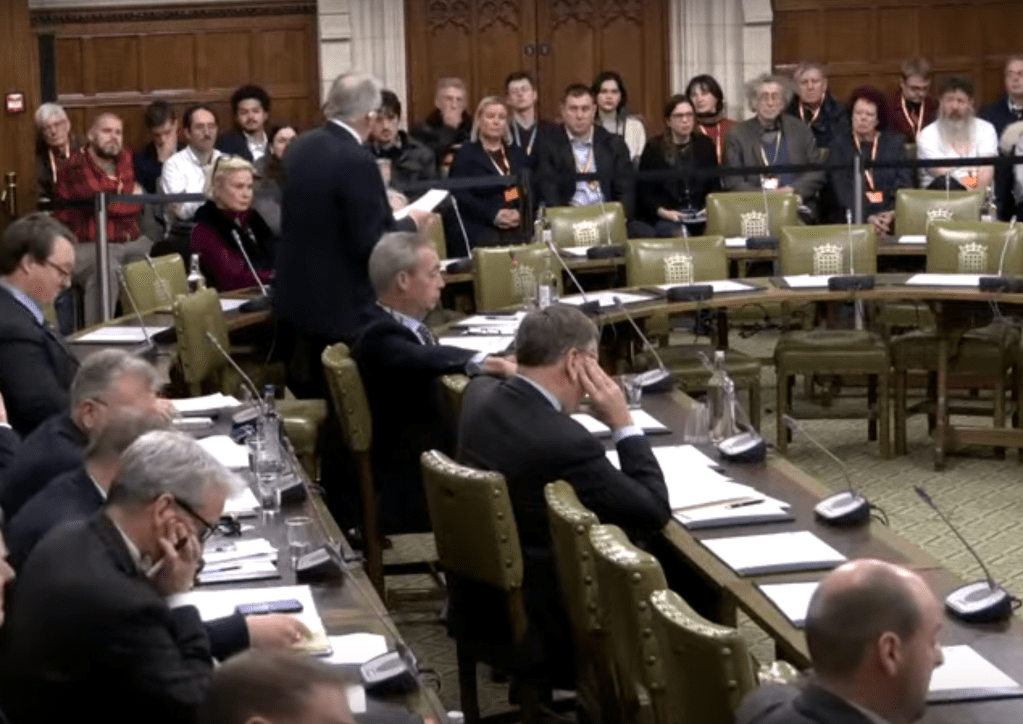
LONDON: A petition for a general election confronted members of the house of commons on Monday in a rude return from a seventeen day Christmas break.
Publican Michael Westwood created the petition on the claim that the government has not held its pre-election promises.
The petitions committee considers for debate any petition which receives above 100,000 signatures. Westwood’s gained over 3 million.
Westwood sat in the gallery behind a cordon separating members of parliament from members of the public.
He might have been disappointed he came.
“It is always encouraging to witness public participation in politics,” said petitions committee chair and scottish liberal democrat mp Jamie Stone, who was in westminster worship mode. “The fact that we’re here today in this place, debating this matter is surely evidence that we live in a democracy where our electorate can, can express discontent and can demand our attention and know that we will listen to them and take their concerns seriously!” he assured.
Just one caveat: the petition’s demand would not be considered. “An election cannot be called as a result of a petition. It simply cannot … until the prime minister seeks permission from the sovereign to dissolve parliaments at a time of his choosing,” Stone said, without delving into the democratic merits of that system.
“That is the way we do things in this country,” Stone added triumphantly.
Soon, debate chair and labour mp Carolyn Harris provided a reality check. “Before I continue with the debate, can I just bring to everyone’s attention that guests in the gallery are not permitted to contribute in any way to the debate,” she stated.
So much for the deemos. Despite Harris’ disregard, Westwood stayed put.
Members of parliament took their turns to speak and introduce their own agendas. Labour mp Yasmin Qureshi said misinformation and foreign interference had influenced signatories, a reference to social media boss Elon Musk promoting the petition on his platform. “Labour inherited the fastest growing economy in the G7,” offered conservative mp Mark Francois. Conservative mp sir Edward Leigh used his time to deride public alienation by way of migration and solar panels.
Opposition members argued the government had broken its promises. Labour members said the government needed to raise money. Little to no time was given to the demand of the petition – that there be a general election.
Those who discussed the crux of the petition rejected its notion outright. “It is, I think, absolutely intrinsic to the proper functioning of democracy to respect and uphold the democratic mandate the current government holds from the British public,” said Stone.
“[Not] to do so would fundamentally undermine the existing institutional constitutional mechanisms that empower the public,” little able to contain his passion for public empowerment.
Plenty had their say, but none considered that the public should have the right to call an election at a time of their choosing, the most democratic arrangement possible within an electoral system.
“Just over 4,000 people signed this petition in my constituency … but 18,000 plus voted for me and the labour party on the fourth of july … and i will not allow what effectively amounts to an online vote exacerbated by Twitter to overrule the votes of more than 18,000 people … we had a free and fair election in this country where every eligible adult was allowed to take part and those who wanted to vote voted and the result of that vote was a majority for the labour party,” said labour mp Mark Ferguson, who noticed no democratic limitation in the choice given to voters at five year intervals: a handful of party endorsed candidates within a geographical boundary.
For labour mp Deidre Costigan, there had been quite enough democracy now for a good while. “What would Brenda from Bristol say about this petition’s call for a general election? I think she’d say ‘not another one’ and I think she’d rightly say we should stop wasting our time debating pointless motions,” Costigan said, zealously certain of her right to represent the views of others without consulting them.
“We all know that we live in a parliamentary democracy and there doesn’t need to be an election until the summer of 2029 and there probably won’t be one, however many petitions are produced,” sir Edward Leigh said, presumably satisfied with his peculiarly long work contract.
Mind reader and reform mp Nigel Farage knew petitioners’ motives better than they. “I don’t think the 8,000 people in Clacton that signed this did so just to get a fresh general election, because they knew that wouldn’t happen,” he said.
“What they were actually expressing was a sense of utter disenchantment with the entire political system,” Farage said. Liberal democrat mp Rachel Gilmour had earlier touched on the same, criticising the electoral system, to laughter from mps.
Presuming the petitioners sincere, if not before they were surely disenchanted with the political system by the end of the debate, which served to reveal that the political system is not only undemocratic, but is antithetical to democracy. The system’s sole democratic mechanism – elections – may only come at the discretion of the most powerful person in the system. Even if, for example, every person of voting age were to sign a petition demanding an election.
Westminster newcomer Farage smelt trouble. “Something bigger is going on out there. The second lowest turnout ever in a general election … the labour party got a third of the vote and two thirds of the seats. For every labour mp there are 34,000 votes, for every reform mp 820,000 votes … Perhaps it’s not surprising that confidence in the whole system is breaking down,” he said.
“I think the whole system is in need of absolute fundamental change and I suspect that this is just a symptom, frankly, is a symptom of a much bigger cry for a different kind of politics in the United Kingdom. You can all con yourselves as much as you like. The old two party system of breaking up before our eyes,” he added.
Conservative sir John Whittingdale may have regretted opting to speak part way through his time, inadvertently admitting that the system is not fit for purpose. “Our system is designed to deliver a quote strong and stable government and most of the time it does that. And I remain a supporter of the system of government … it is the case that our system was built essentially for when there were two main parties … we now have not just a third but a fourth and in some areas a fifth minority. That has produced this extraordinary result that the present government has a majority of 100 seats in parliament having achieved fewer votes than that party achieved under the leadership of the last leader of the labour party, the member for islington north,” referring the the 2019 election won by his own party.
But it was all a bit much for labour minister Ellie Reeves, who was too tired for another election. “I served as labour’s deputy national campaign coordinator in the run up to the general election so the prospect of another general election so soon after the last one and a return to the 5am daily starts fills me with what i can only describe as joy,” she said sarcastically.
“Thankfully as a number of honourable members have said today, our political system does not work on the basis that those who do not like the result of any particular election are granted a rerun. In the words of the member for boston and skegness ‘you back the will of the people and the losers have to consent to the winners’ that’s how democracy works,” Reeves added, clearly considering herself an expert in such matters.


Leave a Reply